 Zkswap
 liquidity pools record deposits as pool shares or individual NFT positions
Zkswap liquidity pools hold token reserves for swaps and record liquidity ownership differently across V2 and V3 designs. Classic V2 pools issue fungible LP tokens that represent a pool share. V3 pools use a non-fungible token (NFT) to identify each position and its chosen price bounds. Those bounds determine whether concentrated liquidity participates in trades at the current pool price.
zkSwap Finance also has a Stableswap design for closely priced assets. Pool ownership, trading-fee income, and farming participation describe different parts of liquidity provision. Choosing a format starts with the assets and the conditions that keep the position productive.
Selecting a pool before the supply transaction
- Match the wallet network and exact token contracts to the selected pool.
- For classic V2, prepare equal-value amounts of the paired assets, or use Zap to balance the inputs.
- For V3, choose the price bounds and fee tier; immediate activity requires the current pool price inside those bounds.
- If farming is intended, identify a corresponding farm that accepts the selected liquidity position.
Keep comparisons of amounts and ranges at the preview stage until those choices are settled. A spending approval authorizes token use; it does not by itself create liquidity. Successful supply appears as a V2 LP-token balance or liquidity recorded against a V3 position NFT. A pending transaction alone does not establish that deposit.
V2 shares and V3 positions carry different information
The ownership record reflects how the pool uses deposited capital. Classic liquidity spreads across the price curve, whereas concentrated liquidity occupies selected bounds. This changes what the record needs to describe, even when both formats support trading between the same assets.
Fungible shares in a V2 pool
LP means liquidity provider. Units of the same V2 LP token represent interchangeable shares of the same pool. The token balance expresses the size of the provider’s claim relative to total LP supply. Another pool issues a different LP asset, so a familiar pair name alone does not identify the token that a farm accepts.
Individual positions in V3
Each V3 liquidity position has a unique NFT representation. Positions can differ in their price bounds, so an aggregate token balance cannot describe every position’s settings. Its identifier keeps that position’s liquidity and fee accounting distinct.
The selected interval
The lower and upper prices define where the position supplies active liquidity. Its fee income depends on the trades through that interval and the other liquidity active there.
The position identifier
The NFT identifies a particular liquidity position; it does not promise a fixed withdrawal value.
What happens to a V3 position outside its price range?
An out-of-range V3 position stops supplying active liquidity and earning swap fees while the pool price remains outside its bounds. The position still holds assets. Inactivity describes its participation in swaps, rather than the disappearance of the deposit or its ownership record.
Swaps change the composition of concentrated liquidity as the price moves through its interval. Beyond a boundary, the liquidity principal consists of one of the paired assets. Which asset remains depends on the direction of the price movement and how the pair expresses its price. Previously accrued fees are separate from that principal composition.
V3 Farm2Earn rewards also require eligible staked liquidity to cover the current pool price. Staking an inactive position does not bring its range back into use. If the price returns inside unchanged bounds, remaining liquidity becomes active again.
A tighter interval leaves less room for price movement before inactivity.
Trading fees and farming rewards measure different earnings
Trading-fee income comes from swaps through the pool, while Farm2Earn adds incentives for eligible staked liquidity. A swap-fee percentage applies to the traded amount. The liquidity-provider allocation describes the portion of that fee assigned to providers, with a separate protocol portion. These percentages describe different bases and should not be read as an annual return.
Fee tiers and allocations vary across pool designs and configurations. A provider’s earnings also depend on trading activity and their share of the liquidity that participates. ZF liquidity incentives draw on their emission allocation separately from trading-fee income. Supplying liquidity and staking its supported position in Farm2Earn are distinct actions. Possession of an LP token or NFT alone does not confirm a farm deposit.
Swap2Earn scores trading activity. Its points do not measure the fraction of pool liquidity that an LP owns.
Which assets suit Stableswap pools?
Stableswap targets stablecoins and other closely priced assets, using a pricing curve that combines constant-product and constant-sum behavior. Around closely matched prices, this design reduces the price movement that a swap causes. Providers supply the reserves that support those trades and receive allocated trading fees.
The pricing design targets a relationship between asset values; it does not maintain each asset’s underlying backing. A broken peg changes the economic exposure of the pool. Low slippage near a peg therefore does not remove the risk of holding an asset that loses value relative to its partner.
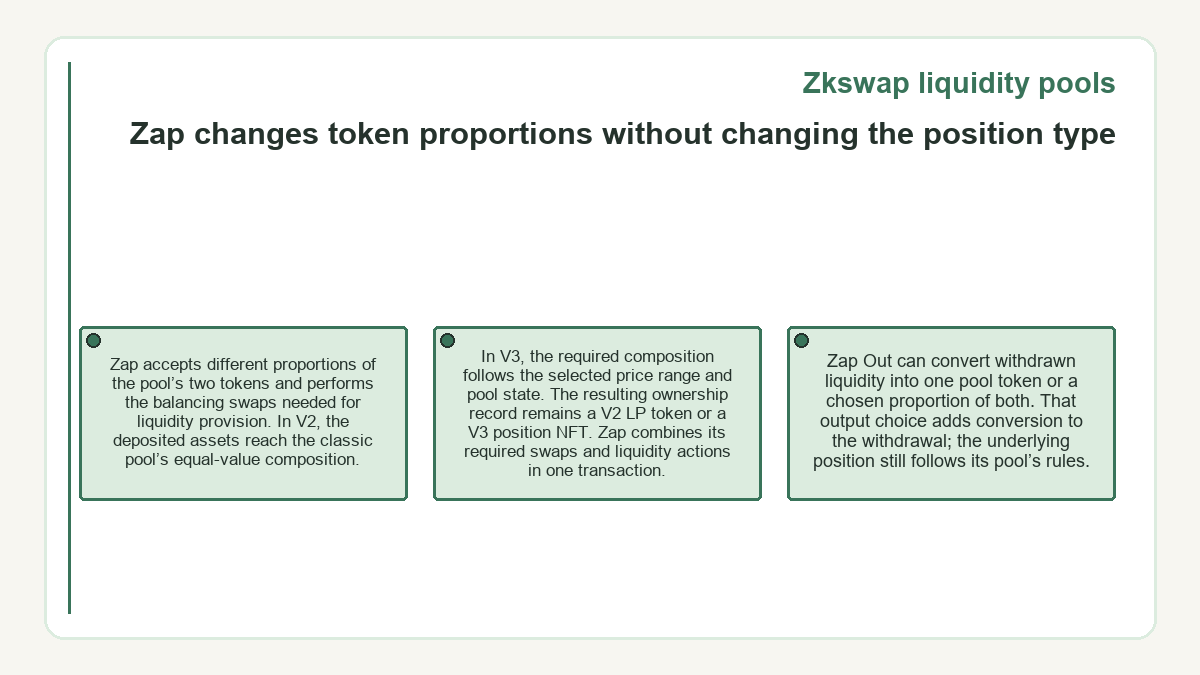
Zap changes token proportions without changing the position type
Zap accepts different proportions of the pool’s two tokens and performs the balancing swaps needed for liquidity provision. In V2, the deposited assets reach the classic pool’s equal-value composition. In V3, the required composition follows the selected price range and pool state. The resulting ownership record remains a V2 LP token or a V3 position NFT.
Zap combines its required swaps and liquidity actions in one transaction. Zap Out can convert withdrawn liquidity into one pool token or a chosen proportion of both. That output choice adds conversion to the withdrawal; the underlying position still follows its pool’s rules.
Position value follows reserves and relative prices
Liquidity provision changes the assets held as traders exchange one pool token for the other. The resulting position can be worth less than keeping the starting assets outside the pool. Impermanent loss describes that relative shortfall before counting fees and incentives. A position can therefore earn fees while underperforming the original token holdings. Neither an NFT identifier nor a stable LP-token balance fixes the market value of the underlying assets. The comparison uses current asset quantities and prices, separate accrued fees, incentive tokens, and execution costs. Fees already reflected in pool reserves need no second addition.
If relative prices move, a direct liquidity withdrawal returns the position’s current composition, which can differ from the starting token amounts.
Things people ask about Zkswap liquidity pools
Does choosing full range turn a V3 position into V2 LP tokens?
A full-range V3 position still uses a position NFT. Full range describes the position’s price coverage, while V2 and V3 describe different pool designs and ownership records. The full-range V3 farming route therefore retains the V3 position format, even though its broad coverage resembles classic liquidity.
Are equal-value deposits equal numbers of each token?
Equal-value deposits match the value of the two assets, not their token counts. Different token prices normally require different quantities to reach that balance. The classic V2 requirement concerns the assets entering the pool; Zap can perform balancing swaps when the starting input proportions differ.
Which figures determine the assets behind a V2 LP-token balance?
A V2 LP-token balance needs the pool’s current reserves and total LP-token supply to determine its underlying asset amounts. The balance represents a proportional claim, so multiplying that share by each reserve gives the corresponding token quantity for a proportional withdrawal. Token prices then determine the value of those quantities.
Why might staked LP tokens disappear from my wallet balance?
LP tokens deposited into a farming contract are no longer part of the wallet’s unstaked token balance. The farm records the deposit for that wallet on the same network. This distinction separates freely held LP tokens from staked liquidity; a lower wallet balance alone does not show that the underlying pool assets have disappeared.
Can a successful Zap preview still end in a reverted deposit?
A successful V3 Zap preview does not guarantee that its deposit will execute. Zap checks pool state again during onchain execution, when prices or available output may differ. Its slippage and minimum-liquidity protections revert the operation if swap output or added liquidity falls below its required minimum. Those checks protect execution conditions, rather than future position value.
Is a liquidity position NFT the same as an NFT used in Tokenize NFT?
A V3 position NFT identifies deposited liquidity and its settings. Tokenize NFT instead accepts ERC-721 collectibles and creates ERC-20 tokens backed by those deposits. A resulting ERC-20 token can become an asset in a compatible pool; the LP token or position NFT represents the separate liquidity deposit.
Will switching wallet networks move my liquidity position?
Changing the network selected in a wallet does not transfer an existing liquidity position. The pool and its ownership record belong to their deployed network and contract instance. A pool view limited to another network can therefore omit the position even when the wallet address matches.
How does Swap2Earn Boost relate to liquidity-farm rewards?
Swap2Earn Boost multiplies trading-point scores using the participant’s DAO-staked ZF. It does not describe the ownership share represented by an LP token or V3 position NFT. Liquidity farming follows the corresponding farm’s eligibility and reward rules, so the trading-point multiplier should not be used to calculate a pool position’s fee income.
Last updated ·