 Zkswap
 NFT deposits, fractional trading, and redemption
Zkswap uses Tokenize NFT to mint one ERC-20 token for each deposited ERC-721 NFT. The resulting token can trade in fractions, while redemption requires whole tokens and follows the deposit queue. Fractional ownership therefore concerns a divisible ERC-20 balance backed by deposited collectibles. It does not attach a specific NFT identifier to every fraction that changes hands. A collection can also have separate token deployments with different parameters, so the particular ERC-20 token contract matters when connecting a trading balance to the NFTs available for redemption within that deployment. Token quantity and the identity of the redeemable NFT answer different questions.
Bottom line: A whole token meets the redemption amount requirement, but the NFT deposit queue determines which collectible the holder receives.
Deposited NFTs determine the minted token quantity
The number of deposited NFTs determines how many whole ERC-20 units the conversion mechanism creates. Its one-token-per-NFT rule counts deposited items. It does not use the collection’s trading volume or a quoted sale price as the minting basis.
Fractional trading takes place within that ERC-20 balance. Dividing a token for trading does not divide the original ERC-721 item into separately identifiable NFTs. The deposited item remains part of the inventory that supports redemption, while ownership of the corresponding fungible units can change.
ERC-721 identity and ERC-20 balances
The two standards describe different assets within the same feature: identifiable NFTs on the deposit side and fungible units on the trading side.
The deposited item
An ERC-721 NFT has an individual token identifier within its collection. That identifier distinguishes the deposited item from other NFTs in the same collection. Tokenization connects that item to a fungible balance without making all the collection’s NFTs identical. The identity of the backing item remains relevant when considering which NFT the redemption mechanism can return.
The tradable balance
An ERC-20 token represents units that holders can transfer and trade in divisible amounts. Fungibility applies within that particular token contract. It allows balances to circulate without attaching an individual NFT identifier to every fraction. A balance identifies how many units a holder controls; the redemption rules determine how those units relate to available NFTs.
The conversion parameters and their scope
The feature links an accepted NFT deposit to a specific token deployment through the following conversion rules.
| Parameter | Value | Applicable asset or inventory |
|---|---|---|
| Deposit format | ERC-721 NFT | The NFT that enters tokenization |
| Issued format | ERC-20 token | The collection-token deployment |
| Minting ratio | One whole token per NFT | Accepted NFT deposits |
| Redemption denomination | Whole ERC-20 tokens | Tokens for the corresponding NFT inventory |
| NFT selection order | First-in, first-out | NFTs available in the redemption queue |
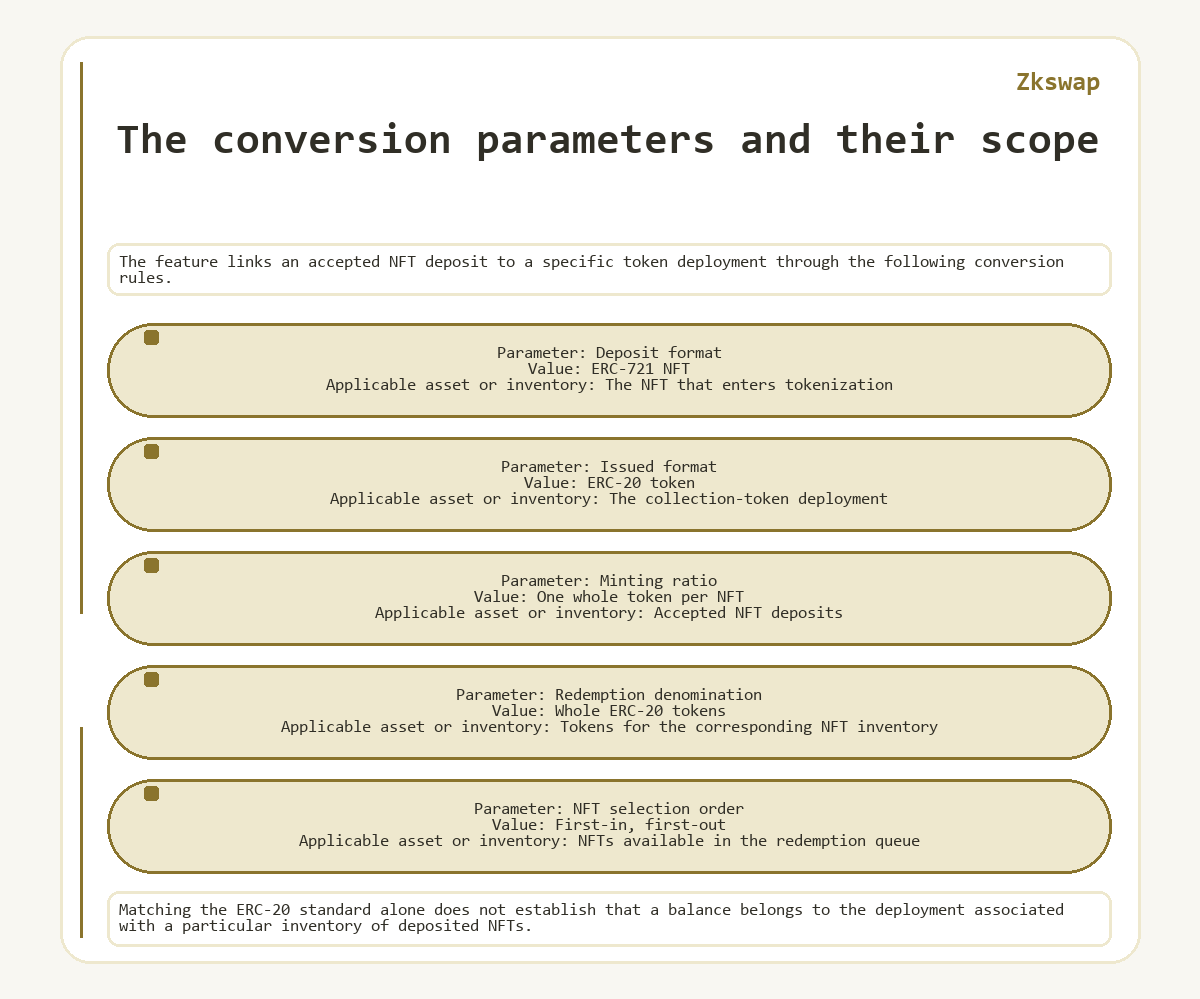
Matching the ERC-20 standard alone does not establish that a balance belongs to the deployment associated with a particular inventory of deposited NFTs.
Can a fractional token balance redeem an NFT?
A balance below one whole ERC-20 token cannot redeem an NFT because redemption requires whole tokens. Trading can concern part of a token; redemption must satisfy the whole-unit requirement for the corresponding inventory.
Tokenize NFT burns whole ERC-20 tokens to release deposited NFTs. A balance that includes whole units and a fractional remainder does not turn that remainder into a partial ERC-721 item. The fraction remains a fungible balance, and the NFT remains individually identifiable.
The redemption queue determines the returned item
Tokenize NFT selects NFTs for redemption in first-in, first-out order. Earlier deposits take priority over later deposits that remain in the same queue.
That ordering matters when a collection contains distinguishable items. A whole ERC-20 token supplies the required redemption denomination. It does not, by itself, give its holder a choice among every NFT that supports that token.
Depositing a particular NFT also does not reserve its return to the original depositor. Fungible tokens can change hands, and the queue governs subsequent redemption.
The NFTs available for a later redemption reflect the inventory remaining at that point. An earlier redemption can change which item comes next. Someone seeking a particular token identifier therefore faces an item-selection constraint in addition to the whole-token requirement.
Collection names and separate token deployments
The first tokenizer sets a new token’s name and symbol, and other deployments can use different parameters for the same collection.
Names and symbols
A chosen name makes the fungible token recognizable. It does not uniquely establish the relationship between that token and deposited NFTs. The collection and the specific ERC-20 contract supply more precise identities than a symbol alone.
More than one token for a collection
Permissionless deployment allows additional tokens for the same NFT collection with different parameters. Collection membership therefore does not make every related ERC-20 token interchangeable. Fungibility belongs to each individual token, even when several tokens refer to the same collection.
Redemption must correspond to the token deployment associated with the relevant NFT inventory. A whole balance of another collection-related token does not establish the same redemption entitlement.
Fractional trading needs an available market
ERC-20 conversion makes fractional trading possible, while actual execution requires a buyer or a compatible liquidity pool. The ability to represent an NFT through fungible units does not create demand for those units. It also does not establish a fixed exchange price.
A market concerns the particular collection token that participants trade. Liquidity for another token from the same collection does not automatically supply liquidity for this deployment. A displayed balance establishes ownership of units, not the amount that a sale will receive.
V2 and V3 pools use the tokenized asset
Tokenize NFT includes liquidity provision on V2 and V3 pools among the uses for its ERC-20 output. Where a compatible pool exists, the fungible token can participate in that pool’s trading liquidity.
Tokenization creates fungible units backed by deposited items. Liquidity provision places tradable assets into a pool that supports exchanges. Pool participation adds its own requirements; the ability to mint a collection token does not establish the existence of a suitable pool or a particular yield.
Initialization charges and transaction costs
Creating a collection token and minting against an existing token involve different fee categories. The Tokenize NFT documentation lists a 2 MON initialization charge for creating a collection token, with no separate tokenization or redemption fee. The creation charge concerns setting up a new collection token, not each later NFT deposit into that token. Network transaction charges, swap costs, and bridge costs remain separate inputs.
Bridging a token and releasing an NFT
A bridge route can move a tokenized balance only where the service supports the particular asset and relevant networks.
The ERC-20 representation
Support for ERC-20 assets in general does not establish that every bridge accepts every collection token. The network and token instance determine which representation a recipient holds.
The ERC-721 redemption
Moving a token representation between networks and redeeming an NFT describe different outcomes. A bridge transfer does not itself demonstrate that an NFT has left its tokenization inventory. Redemption concerns the associated deposited items and the whole tokens that the mechanism accepts. Bridge support does not change the whole-unit requirement on the NFT redemption side.
Fractional exposure and individual collectible value
A fungible balance provides divisible exposure to the NFTs that support its token, while each underlying NFT retains its identity. The conversion ratio does not establish equal market values for all deposited items. Differences between individual collectibles can therefore matter even though redemption uses the same whole-unit denomination.
Trading fractions addresses an amount decision: how much of the fungible asset changes hands. Seeking a particular collectible addresses an identity decision: which deposited NFT becomes available for redemption. The queue limits that second decision. The unit relationship remains one whole ERC-20 token per deposited ERC-721 NFT.
Common questions, answered
Can several NFTs be tokenized or redeemed together?
Tokenize NFT supports depositing or redeeming multiple NFTs through batch operations. Batching handles several items together while retaining the one-token-per-NFT minting relationship and the requirement to burn whole tokens for redemption.
Does the ERC-404 inspiration change the NFT standard that Tokenize NFT uses?
Tokenize NFT draws inspiration from ERC-404 and uses ERC-721 deposits linked to ERC-20 tokens. That inspiration does not change the input and output standards of this conversion mechanism.
Are deposited NFTs destroyed when ERC-20 tokens are minted?
The deposited ERC-721 NFTs remain the assets available for redemption. The burn in the redemption mechanism concerns whole ERC-20 tokens, which the holder exchanges for NFTs from the inventory.
Is the minted collection token the same asset as ZF?
The token minted against NFT deposits belongs to the chosen collection-token deployment, while ZF is the platform’s protocol token. Its one-token-per-NFT minting ratio is not a conversion rate into ZF.
How does an NFT-backed token differ from a V2 LP token?
An NFT-backed token comes from depositing an NFT into tokenization, while a V2 liquidity-provider token represents a share of a liquidity pool. Providing a compatible NFT-backed token as pool liquidity does not make the original collection token and the resulting LP token the same asset.
Last updated ·